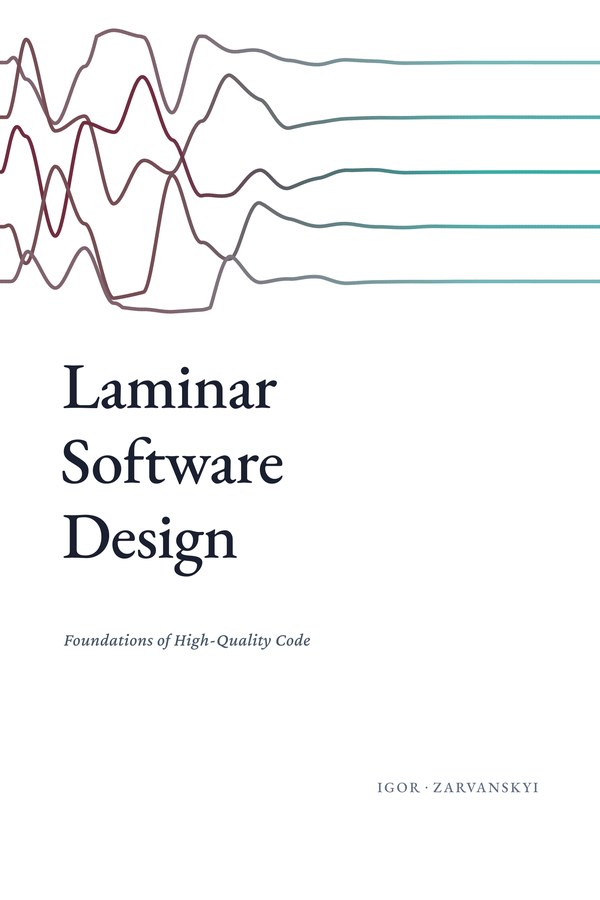
Laminar Software Design: Foundations of High-Quality Code is a book about what good code means and how to write it. It defines good code through three timeless qualities: simple to understand and change, correct in behavior and fast enough for its purpose. Code with all three qualities at once the book calls laminar, and such code comes only from deliberate design. After reading the book, you will be able to name what is wrong with code instead of only sensing it. You will see when naming is hard because the design is wrong, know when code is simple enough to stop, and write new code that stays simple as it grows.
Examples are in Java and follow one e-commerce domain, but the ideas apply to any language. They also reach beyond software, because they rest on the limits of the human brain, which hold for anything a person has to understand and change.
Amazon Paperback Amazon Kindle Google Play Books
Why this book
In twenty years of building software I worked with many codebases, and most of them were turbulent. By turbulent I mean code that is hard to understand and hard to change, that keeps producing bugs, and that runs slower than it needs to. Code reaches that state on its own, because every change made without a deliberate design decision moves it a little further in that direction. So keeping code out of that state takes knowledge, and the question is where a developer gets that knowledge from.
On the teams I worked with, that knowledge came from me: I taught each developer how I expected code to be written, one pull request at a time. Every review comment carried a reason, yet those reasons were never written in one place, so a developer could learn them only from the comments on their own code. The book is my attempt to write that knowledge down once, together with the reasons behind it.
Those reasons rest on three sources: seventy years of software history, cognitive science and my own experience. History shows which problems in code keep coming back, whatever the tools are. Cognitive science explains how human understanding works, and the book applies that explanation to code. My own experience shows which design decisions keep code easy to change and which slowly make it turbulent. That experience comes from twenty years of work, mostly on enterprise systems for Clarks, Trek Bicycles, ABB and others, which have been running and changing for more than ten years.
What is inside
The book has twelve chapters in five parts:
- The Timeless Qualities: what good code means, and why the history of the field points to simple, correct and fast enough.
- Simplicity: how the brain reads and changes code, and the two principles that follow from it, encapsulation and the single level of abstraction. The part shows how to apply them at every scale, from a single method to a distributed system, and where simplicity most often breaks.
- Correctness: how types and design prevent whole kinds of errors before the code runs, and how tests catch the errors that design cannot prevent, in a workflow that ends in verified results.
- Performance: how to tell when code is fast enough, why speed cannot be judged from the code alone, and how to remove the visible waste and measure the result.
- Software Design: how the three qualities and the two principles become one activity of creating abstractions, with a workflow for everyday practice.
How the book was written
The ideas, the structure and the examples of the book are mine, and I used AI tools as drafting assistance, mostly Claude Code. A separate post describes the whole process, from the first plan to the skills and the AI reviews that checked the text: How I wrote the “Laminar Software Design” book.
Related articles
Quoting and citing
Passages of the book may be quoted without prior permission, as long as each quotation names the title and the author of the book. This holds for articles, reviews, academic writing, blog posts, talks, code reviews and similar professional or educational contexts. For the code examples the terms are wider still: anyone may copy, change and use them without permission or attribution, commercial work included.
To cite the book:
Zarvanskyi, I. (2026). Laminar Software Design: Foundations of High-Quality Code. Independently published. ISBN 978-84-09-85928-3.